Senators want to know more about how districts spend funding
Source: California Aqueduct.
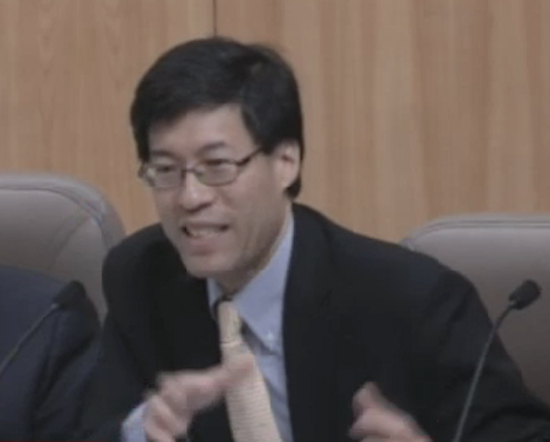
Country Sen. Richard Pan questions Country Board members Michael Kirst and Sue Burr.
 Source: California Channel.
State Sen. Richard Pan questions State Board members Michael Kirst and Sue Burr.
Country senators pressed members of the Land Board of Education on Wednesday to tell them whether dollars spent for schools under a new system of local control are being spent finer.
"Are we getting our coin's worth and how do nosotros know?" Sen. Marty Block, D-San Diego, asked during a Senate Education Committee hearing.
He and other senators didn't go a simple or fully satisfying response from State Board President Michael Kirst and board member Sue Burr. They told the commission, in an otherwise upbeat assessment of landmark changes the state is going through, that it's too soon to know.
In the past three years, Block said, school districts have received $xiii billion in new funding. Funding per student varies by district nether the Local Control Funding Formula, or LCFF, in which revenue is distributed partly co-ordinate to enrollment of depression-income children and English learners. So information technology's been a big increment for some districts, nevertheless barely enough to bring spending dorsum to pre-recession levels for others with few loftier-needs students.
Districts are required to account for spending in a Local Control and Accountability Plan, in which they prepare three-year goals and priorities and and then update annually. County offices of education must review and approve each LCAP, but Kirst best-selling that the state is not compiling and studying data on how districts are spending money under the funding formula.
That troubled Sen. Richard Pan, D-Sacramento, who said that legislators desire to know how the state is spending overall education dollars. "That data is out in that location. Shouldn't we be gathering it to know about bear on?"
Kirst noted the challenge of striking a residuum between flexibility and accountability under the new law. The Legislature, in passing LCFF, did away with dozens of categorical programs that dictated district spending. At the aforementioned time, the general accounting categories required by the state are too broad for useful comparisons, he said. They won't differentiate betwixt spending for counselors, lowering grade sizes or hiring new English teachers.
Then that's a trouble, Pan said, and it extends to tracking spending at the school level, too. "There need to be some standardized definitions for parents to have a better handle on how districts are allocating resources. We always say, 'Budgets indicate priorities.'"
Burr said that parents must examine spending in the LCAP and then the annual updates to see how the money was really used. But critics have pointed out the LCAP is vague on requiring itemized expenditures for the supplemental dollars that districts receive for low-income students and English learners. Coin for those students that is not spent at the stop of the year is non earmarked for the following year.
Kirst said that the claiming is non to make the LCAP more than complicated than it already is by adding details that will turn off parents and community members from reading it. But he as well best-selling that he is "not satisfied with where we are at present."
Mutual criticisms he has heard, he said, are that the LCAPs are also long, complex and hard to understand, that there is a lack of connectedness between LCAP priorities and a district'southward overall upkeep, and that in that location is not enough information on how money is being used to meliorate or increase services for students targeted for extra coin.
The state board is because amending the LCAP template and will hash out ideas at its May coming together, with a program to prefer changes in the fall.
New measurements of accomplishment
Along with rolling out a new funding system, the state has adopted new standardized tests for the Common Core standards, and the state board is developing a new system to measure student achievement; it volition be adopted this autumn.
Accountability remains a piece of work in progress, complicating an ability to measure out immediate results. Burr pointed to high school graduation rates, which accept increased for all students and dramatically for some low-performing subgroups of students. The state has one-yr results on the Smarter Balanced tests, measuring operation in English linguistic communication arts and math based on Common Cadre standards, with a 2nd year out side by side summer. The country will be using a handful of other metrics, across test scores, as well, Kirst said, although they have not yet been chosen.
Merely he and Burr said that statewide metrics are merely one slice of operation. Districts also set their own priorities in their LCAPs, and those goals must be measured too.
Oakland Unified, said Kirst, is spending essentially on career pathway programs, and then a key metric should be how well it is implementing them.
Rick Miller, executive director of Core, the California Office to Reform Pedagogy, reiterated that view. The six districts in Cadre, which include three of the four largest in the state – Los Angeles, Long Beach and Fresno – accept created their own School Quality Improvement Index with metrics on school climate and middle schoolhouse readiness that the state doesn't currently require and probably won't in the futurity.
All accountability systems should non look alike, Miller said during the hearing. The state should not impose a single system merely should "permit districts to improve with local innovation."
Wednesday was an advisory hearing, with legislators expected to have upward their own ideas for accountability through the budget or legislation in coming months.
To get more reports like this one, click hither to sign up for EdSource's no-price daily email on latest developments in pedagogy.
williamsthislem90.blogspot.com
Source: https://edsource.org/2016/senators-want-to-know-more-about-how-districts-spend-funding/95240
0 Response to "Senators want to know more about how districts spend funding"
Post a Comment