A Light Inside an Oddyssey of Art Life and Law
Shot Caller was the nearly physically demanding film I ever shot: an authentic wait at our prison gangs and the police force enforcement professionals who guard them inside prison walls and hunt them down on the streets.
In order to go a real-earth grasp of prison and the gangs that run these institutions, I went hugger-mugger every bit a volunteer parole agent in California. What started out every bit a elementary research assignment became a two-year odyssey as doors kept opening, allowing me more than and more admission into this violent globe.
No one knew I was a filmmaker. They just saw me as a rookie cop, and then nil was censored. What I quickly learned is that though the guards might command the doors and gates, the gangs run the prisons… and they run the streets as well, directly from prison.
The picture show takes place over 10 years and we wanted it to bear witness unlike levels of incarcerations and how older prisons, likewise equally new, modern prisons, look. The only set we had to build was the Security Housing Unit—there are no real ones that are available to shoot in—simply the rest were all real.

Director Ric Roman Waugh (heart) harnessed the assistance of dozens of real-life convicts as extras in his prison drama Shot Caller
We researched extensively on what different institutions expect similar, from their exteriors to the the visiting areas. Every ready Nikolaj Coster-Waldau (who plays Jacob, my protagonist) encounters on his journeying is authentic to its real-world counterpart, correct down to the warnings on the wall. Our boosted research included spending time with, and hearing the stories of, old prison gangsters and "shot callers," the kingpins of the power structure inside, and ofttimes exterior, the prison system. The men gave us total accounts of prison and gang politics and what it really takes to survive prison house, which included bright descriptions of how the gangs acted within their own peer groups, and how they responded to and manipulated new recruits. This was not only a philosophical exercise—subscribing to this code literally defined one's chances of survival inside.
I learned the emotional context and behavioral mores of this prison "fraternity." Starting time, the gangs, divided mostly along racial lines, lure in the newbie with the promise of protection of numbers, calling the recruit their brother. Only this security comes with a price: Said newcomer is then instructed by the gang to deport out its orders without question, even if it meant using lethal force. There's no choice, information technology'southward the cost of membership: Stab or be stabbed. On and on it goes, escalating over the years so that this type of beliefs seems normal and indeed remains the departure between life and death—often even after release.
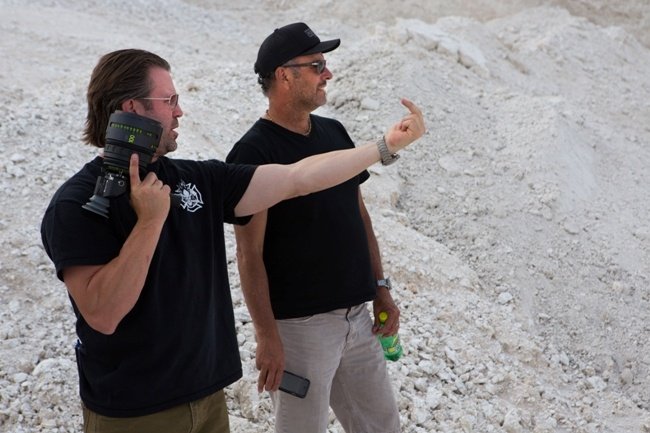
Waugh and DP Dana Gonzales on the prepare of Shot Caller
DP Dana Gonzales and I dearest shooting in real locations. Nosotros prefer its authenticity and information technology as well gives actors an edge, versus sitting in a cushy soundstage with imitation walls. Dana has become a primary of lighting in real settings, using practical lighting instruments to be the key calorie-free while beingness in the shot too. We shoot 360 degrees nigh of the time, so embracing the practical lighting approach helps united states attain that.
You have to schedule your day differently shooting in existent prisons, even a vacant 1. Example: The empty prison nosotros used for Chino (with the three tiers of erstwhile iron bars), most coiffure had to push their equipment and carts a quarter mile through hallways to get to it. Even actors had to walk that far betwixt shots from makeup. In the active prisons, you have to business relationship for security and allowing time for the guards' process. That's the price you pay for getting a real location. In turn, there's an accuracy and credibility that nosotros couldn't achieve elsewhere—non simply merely because the set is a prison, but considering information technology also contributes to the overall sensibility and mindset, for the cast and the coiffure.
Yes, nigh every background actor was a one-time convict or gang member. I love filming with them. When yous treat someone with respect and brand them experience a part of the process rather than cattle, they will give you everything they have with the same respect dorsum. In the riot scene, there were more than 200 guys involved, and we had cipher incidents. It was bang-up to see formal rivals of different factions and races making it as real every bit possible while in combat, so smiling and assistance each other upwards after we yelled "cut." (Of course, I'm not advising just anyone to do that. Yous demand to sympathize the globe a convict comes from and how to speak to them, and that comes with experience.)

Nikolaj Coster-Waldau as Jacob in Shot Caller
Our biggest challenge was hooting all those locations and getting solid performances in just 22 days. My style was to allow people, both cast and coiffure, contribute to the process, even on such a short shoot. I come prepared but exit tons of room for improv and creative gratis-catamenia, so plenty of nifty things come from that. MM
Shot Caller opened on DirecTV July xx, and in theaters Baronial 18, 2017, courtesy of Saban Films and Lionsgate. An abbreviated version of this article appears in MovieMaker'due south Summer 2017 issue.
williamsthislem90.blogspot.com
Source: https://www.moviemaker.com/shot-caller-ric-roman-waugh-real-life-prison/
0 Response to "A Light Inside an Oddyssey of Art Life and Law"
Post a Comment