What Is the Outline of an Object in Art
This
A like solution—a five-part polyptych reduced to triptych format—in fact appears on the master side of Giotto'due south Stefaneschi altarpiece (Pinacoteca Vaticana, no. twoscore.120) and later (probably at a date close to 1340) in the fragment of a triptych by Jacopo del Casentino now in a private collection; meet Richard Offner,A Critical and Historical Corpus of Florentine Painting: The Fourteenth Century, sec. 3, vol. 7,The Biadaiolo Illuminator, Main of the Dominican Effigies (New York, 1957), pl. xlix. About 1365, Matteo di Pacino revived this scheme in an altarpiece of similar structure now in the Galleria dell'Accademia in Florence (no. 8463); see Michela Palmeri, inDipinti, vol. one,Dal Duecento a Giovanni da Milano, Cataloghi della Galleria dell'Accademia di Firenze, ed. Miklós Boskovits and Angelo Tartuferi (Florence, 2003), 174–181. Peradventure a few years later in date is some other triptych of similar format, attributed to the Chief of San Lucchese virtually Poggibonsi, destroyed in 1944; reproduced in Bernard Berenson, "Quadri senza casa: Il Trecento fiorentino, 2,"Dedalo 11 (1930 – 1931): 1050, as a work by Jacopo di Cione. Another altarpiece of the aforementioned format is the triptych painted by the Chief of the Misericordia and Niccolò Gerini in collaboration, now in the church of Sant'Andrea at Montespertoli near Florence; reproduced in Richard Offner and Klara Steinweg,A Critical and Historical Corpus of Florentine Painting: The Fourteenth Century, sec. 4, vol. 5,Giovanni del Biondo, pt. two (New York, 1969), pl. xliv, equally workshop of Giovanni del Biondo, probably executed around 1380.
The throne is like to the i that appears in the polyptych signed by Giotto at present in the Museo Civico Nazionale in Bologna (no. 284). Thrones of this blazon, with a loftier, triangular-topped backrest simply of uncomplicated structure and convincingly drawn in perspective, appear in the early 1360s in Giovanni da Milano'south polyptych at present in the Museo Civico at Prato; in the fragmentary polyptych by Cenni di Francesco, dated 1370, in the church building of San Cristofano a Perticaia most Florence; in the polyptych by Pietro Nelli and Niccolò Gerini in the pieve at Impruneta, dated 1375; and thereafter always more often in the concluding quarter of the century. Cf. Miklós Boskovits,Pittura fiorentina alla vigilia del Rinascimento, 1370 – 1400 (Florence, 1975), pls. 86 and 61.
On the original decoration of the frame, cf. Mary B. Bustin, "Recalling the Past: Evidence for the Original Construction of Madonna Enthroned with Saints and Angels by Agnolo Gaddi,"Studies in the History of Art: Conservation Inquiry57 (1996–1997): 50–64. The way of roofing the gable zones of altarpieces with pastiglia ornamental motifs in relief before they were gold began to spread from Orcagna'south shop in the second half of the Trecento.
The sumptuous ornament, with pairs of facing animals, of the brocaded fabrics used to comprehend the throne of the Madonna or the flooring on which the saints stand is a phenomenon characteristic of Florentine painting in the second half of the fourteenth century, especially in paintings of the circle of Orcagna, just also in panels produced in the bottega of Agnolo Gaddi. Cf. Brigitte Klesse,Seidenstoffe in der italienischen Malerei des 14. Jahrhunderts(Bern, 1967), 283, 316, 341.
Lionello Venturi published this triptych in 1931 under the name of Gherardo Starnina.
Lionello Venturi,Pitture italiane in America (Milan, 1931), no. 52.
Oskar Wulff (1907) coined this unfortunate conventional name. Osvald Sirén (1914–1915) subsequently altered it to "Compagno d'Agnolo," and shortly thereafter he formulated a hypothesis identifying this artist with Gherardo Starnina (1916, 51–53). See Oskar Wulff, "Der Madonnenmeister: Ein sienesisch – florentinische Trecentist,"Zeitschrift für Kunstgeschichte 20 (1907): 195–210, 227–236; Osvald Sirén, "Early Italian Pictures, the Academy Museum, Göttingen (Conclusion),"The Burlington Magazine for Connoisseurs 26 (1914): 107–114; Osvald Sirén, ed.,A Descriptive Catalogue of the Pictures in the Jarves Collection Belonging to Yale University (New Oasis and London, 1916), 51–53. The proposal was accepted by Raimond van Marle,The Development of the Italian Schools of Painting, vol. 3,The Florentine Schoolhouse of the 14th Century(The Hague, 1924), 565–573, and another authors in the following decade.
Referring to the group of paintings usually cited under the proper noun "Compagno d'Agnolo," Bernard Berenson wrote: "Una delle più singolari aberrazioni della critica recente è stata quella di attribuire tutte queste Madonne allo Starnina; ma non è necessario perdere il tempo a dissipare errori che il tempo stesso disperderà" (One of the about atypical aberrations of modern criticism is that of attributing all these Madonnas to Starnina; merely it is not necessary to waste fourth dimension dissipating errors that time itself volition dissipate). See Bernard Berenson, "Quadri senza casa: Il Trecento fiorentino, 3,"Dedalo 11 (1930–1931): 1303. Subsequently the discovery of the remains of the cycle of Starnina's documented frescoes in the church of the Carmine in Florence, the hypothesis of the bearding primary's identification with Starnina was gradually abandoned. See Ugo Procacci, "Gherardo Starnina,"Rivista d'arte 15 (1933): 151–190; Ugo Procacci, "Gherardo Starnina,"Rivista d'arte 17 (1935): 331–384.
The triptych now in the National Gallery of Art evidently came to Duveen Brothers accompanied by expertises from Robert Langton Douglas and Osvald Sirén, both supporting the attribution to Starnina; see Duveen Brothers,Duveen Pictures in Public Collections of America (New York, 1941), nos. 24–25. Lionello Venturi (1931, 1933), Wilhelm R. Valentiner (1933), and Ugo Galetti and Ettore Camesasca (1951) likewise accustomed that attribution. Roberto Salvini (1935–1936), not accepting the identification Gherardo Starnina = Compagno d'Agnolo, attributed the painting to the latter. Cf. Lionello Venturi,Pitture italiane in America (Milan, 1931), no. 52; Lionello Venturi,Italian Paintings in America, trans. Countess Vanden Heuvel and Charles Marriott, 3 vols. (New York and Milan, 1933), 1: no. 63; Wilhelm R. Valentiner, ed.,The Sixteenth Loan Exhibition of Old Masters: Italian Paintings of the XIV to XVI Century (Detroit, 1933), no. 11; Ugo Galetti and Ettore Camesasca,Enciclopedia della pittura italiana, 3 vols. (Milan, 1951), 3:2351; and Roberto Salvini, "Per la cronologia e per il catalogo di un discepolo di Agnolo Gaddi,"Bollettino d'arte 29 (1935–1936): 287.
The present author proposed that Agnolo Gaddi's altarpiece might have been executed for the sacristy of the church of San Miniato al Monte (Florence),
Miklós Boskovits,Pittura fiorentina alla vigilia del Rinascimento, 1370–1400(Florence, 1975), 118–121.
On Benedetto Alberti's will, see Luigi Passerini, ed.,Gli Alberti di Firenze: Genealogia, storia due east documenti, 2 vols. (Florence, 1869), 2:187. The codicil in question was fastened to the volition drawn up in 1377 (now lost and known only from a seventeenth-century abstract). In it the testator already instructed that "si facessi dipignere la Sagrestia di San Miniato al Monte con gli Armadi et Finestra et af[freschi]" (that the sacristy of San Miniato al Monte should be painted [and provided] with cupboards, [stained glass] window, and frescoes); Giovanni Felice Berti,Cenni storico-artistici per servire di guida ed illustrazione alla insigne Basilica di South. Minato al Monte e di alcuni dintorni presso Firenze (Florence, 1850), 156. So, when Alberti x years after made testamentary provision that the "sacrestia ecclesiae sancti Miniatis advertizement Montem de prope Florentiam compleatur et compleri et perfici debeant picturis, armariis, coro, fenestra vitrea, altari et aliis necessariis" (the sacristy of San Miniato al Monte of Florence should exist completed and perfected with paintings, cupboards, a choir stall, stained drinking glass window, an altar, and all other necessary things), this decoration might already have been planned and peradventure even in part realized. Ada Labriola and Federica Baldini accepted the provenance of the Gallery's panels from the sacristy of San Miniato in Ada Labriola, "La decorazione pittorica," inFifty'Oratorio di Santa Caterina: Osservazioni storico-critiche in occasione del restauro, ed. Maurizio De Vita (Florence, 1998), 52; Federica Baldini, inFifty'Oratorio di Santa Caterina all'Antella due east i suoi pittori, ed. Angelo Tartuferi (Florence, 2009), 159.
Run across Stefan Weppelmann,Spinello Aretino und die toskanische Malerei des 14. Jahrhunderts (Florence, 2003), 381.
See Stefan Weppelmann,Spinello Aretino und die toskanische Malerei des fourteen. Jahrhunderts (Florence, 2003), 381.
Jacopo da Varazze,Legenda aurea, ed. Giovanni Paolo Maggioni, 2 vols. (Florence, 1998), 2:1205.
Although the provenance from San Miniato remains a hypothesis, it nonetheless seems to me a quite plausible one that, if correct, would give the states the certainty that by 1830 the triptych was still on the altar of the sacristy. An altarpiece can manifestly be seen neverthelessin situ in a sketch of the sacristy's altar wall 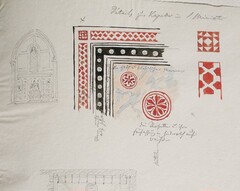 [fig. 1] C. A. R. Roller, ""Pattern of the east wall of the sacristy of San Miniato in Florence,"" from Tagebuch einer italienischen Reise (Periodical of My Trip to Italy in the Years 1829 and 1830), 1:7, June 1830, Rittersaalverein Castle Museum, Burgdorf, Switzerland
Run into "Regesto dell'Abbazia fiorentina di San Miniato,"La Graticola four (1976): 117–135. See Stefan Weppelmann,Spinello Aretino und dice toskanische Malerei des 14. Jahrhunderts (Florence, 2003), 381.
As for its date, the Gallery'south outset catalog (1941) cautiously suggested "the final quarter of the XIVth century," while the book devoted to the Duveen Pictures (1941) proposed an approximate engagement of c. 1380.
National Gallery of Fine art,Preliminary Catalogue of Paintings and Sculpture(Washington, DC, 1941), 69; Duveen Brothers,Duveen Pictures in Public Collections of America (New York, 1941), nos. 24–25.
Miklós Boskovits,Pittura fiorentina alla vigilia del Rinascimento, 1370–1400(Florence, 1975), 118.
Bruce Cole,Agnolo Gaddi (Oxford, 1977), 21–26.
Even the dating of this work, for the nearly part identified with the altarpiece for which Agnolo was paid between 1394 and 1396, has been questioned. What is certain is that payments were made to Agnolo during those years for "la tavola di San Miniato a Monte." In 1396, nonetheless, because the artist had died in the meantime, his blood brother Zanobi received the balance; see Bruce Cole,Agnolo Gaddi (Oxford, 1977), 65, 67. No doubt correctly, art historians generally take assumed that the documents refer to the altarpiece placed on the altar of the crucifix of Saint Giovanni Gualberto in San Miniato, which has come down to united states of america with its components rearranged. Originally, the panels of the polyptych representing the stories of Christ and full-length figures of Saint Giovanni Gualberto and Saint Minias formed an ensemble that must have contained at the center the much-venerated crucifix, which, according to legend, had spoken to Saint Giovanni Gualberto. When the crucifix was transferred to the Vallombrosans of Santa Trinita in Florence in 1671, the painted panels were rearranged in such a manner as to fill the gap created past its removal. Though Cole (1977, 51–56) contested the identification of the existing altarpiece of the crucifix of Saint Giovanni Gualberto with that cited in the documents, his stance met with footling back up. Cole argued instead that the documented painting should exist identified with the triptych of the Contini-Bonacossi bequest now in the Uffizi, Florence. Merely this latter painting has existed in its present form merely since the 1930s, when the dispersed panels of ii dissimilar altarpieces were arbitrarily cobbled together during an unscrupulous restoration; cf. Bruce Cole,Agnolo Gaddi (Oxford, 1977), 51–56; Miklós Boskovits,Pittura fiorentina alla vigilia del Rinascimento, 1370 – 1400 (Florence, 1975), 66, 216 n. 85, 298; Gaudenz Freuler, ed.,Manifestatori delle cose miracolose: Arte italiana del '300 e '400 da collezioni in Svizzera e nel Liechtenstein(Einsiedeln, 1991), 204; Christoph Merzenich,Vom Schreinerwerk zum Gemälde: Florentiner Altarwerke der ersten Hälfte des Quattrocento (Berlin, 2001), 228. Freuler, however, believed that at to the lowest degree the two laterals of the Contini-Bonacossi polyptych formed part of the altarpiece documented in 1394–1396.
Among the punch marks used by Agnolo, Erling Skaug (1994) particularly observed 2 that tin can be identified in Taddeo Gaddi's triptych dated 1334, now in the Staatlichen Museen of Berlin. Skaug inserted the National Gallery of Fine art painting in the late phase of Agnolo Gaddi. Both the investigations of Mojmir S. Frinta (1998) and the later analysis of Skaug himself (2004) largely concurred, however, in suggesting that the very aforementioned punches were used throughout the artist's career. See Erling South. Skaug,Punch Marks from Giotto to Fra Angelico: Attribution, Chronology, and Workshop Relationships in Tuscan Panel Painting with Particular Consideration to Florence, c. 1330 – 1430, ii vols. (Oslo, 1994), 1:260–264; 2: punch chart 8.two; Mojmir Svatopluk Frinta,Punched Decoration on Late Medieval Panel and Miniature Painting (Prague, 1998), 100, 244, 283, 290, 322, 481; Erling South. Skaug, "Towards a Reconstruction of the Santa Maria degli Angeli Altarpiece of 1388: Agnolo Gaddi and Lorenzo Monaco?"Mitteilungen des Kunsthistorischen Institutes in Florenz 48 (2004): 245, 254–255. Some of the punch marks found in the Washington triptych as well appear in the later San Miniato altarpiece, documented in 1394–1396 (on which see annotation 18 above), while others had already been used inCoronation of the Virgin in the London National Gallery, generally considered an early piece of work by the creative person.
In the course of his career, especially between the 1380s and the early 1390s, Agnolo Gaddi produced a number of
Osvald Sirén, "Addenda und Errata in meinem Giottino-Buch,"Monatshefte für Kunstwissenschaft i (1908): 1122–1123, published the central panel with an attribution to Agnolo Gaddi and stated its present whereabouts every bit the Masi collection in Capannoli (Pisa). Information technology is very probable, therefore, that the painting has a provenance either from Pisa or from Capannoli itself, a spa (at present a resort) in the district of Pisa that used to vest to Piero Gambacorti, the governor of Pisa, who owned a castle there; see Emanuele Repetti,Dizionario geografico, fisico, storico della Toscana, contenente la descrizione di tutti i luoghi del Granducato, Ducato di Lucca, Garfagnana due east Lunigiana, xi vols. (Florence, 1833–1849), 1:452. The provenance of the laterals at present attached to this painting is unknown; all we know is that in 1952 they were the property of Alessandro Contini-Bonacossi, who, according to Cole, had purchased them in Rome prior to 1931. Cf. George Kaftal,Saints in Italian Art, vol. 1,Iconography of the Saints in Tuscan Painting (Florence, 1952), 747–748; Bruce Cole,Agnolo Gaddi (Oxford, 1977), 76. Contini then commissioned special frames to be fabricated for them, similar to the original frame of the Madonna from Capannoli. Miklós Boskovits,Pittura fiorentina alla vigilia del Rinascimento, 1370–1400(Florence, 1975), 298, dated the latter to c. 1380–1385, while Cole, as we have seen, considered the recomposed triptych to be 18-carat and associated it with the ii documents of 1394–1396. Caterina Caneva, inGli Uffizi: Catalogo generale, 2nd ed. (Florence, 1980), 277, dated the execution of the whole altarpiece to 1375–1380; Ada Labriola, "Gaddi, Agnolo," inDizionario biografico degli italiani, 82 vols. (Rome, 1998), 51:146, to the 1380s; while Sonia Chiodo, "Gaddi, Agnolo," inAllgemeines Künstlerlexikon: Die bildenden Künstler aller Zeiten und Völker, ed. Günter Meißner, 87 vols. (Munich, 2005), 47:113, mentioned information technology as a "late work."
Boskovits'due south proposal (1975, 117, 296) to attribute the Borgo San Lorenzo Madonna to Agnolo and to date it to 1380–1385 has in substance been accustomed by the more recent literature; cf. Miklós Boskovits,Pittura fiorentina alla vigilia del Rinascimento, 1370 – 1400 (Florence, 1975), 117, 296; Erling S. Skaug,Punch Marks from Giotto to Fra Angelico: Attribution, Chronology, and Workshop Relationships in Tuscan Console Painting with Particular Consideration to Florence, c. 1330–1430, 2 vols. (Oslo, 1994), 1:261; Maria Matilde Simari, "Il Mugello," inIl Mugello, la Valdisieve e la Romagna fiorentina, ed. Cristina Acidini and Anna Benvenuti Papi (Milan, 2000), 56. A modern (nineteenth- or twentieth-century) copy of this painting, attributed to Agnolo himself, was with Wildenstein & Co. in New York in 1954; see Dorothy C. Shorr,The Christ Child in Devotional Images in Italia during the Xiv Century (New York, 1954), 114.
The predella of the painting, at present in the Louvre, Paris, has been recognized as that formerly in the Nobili chapel at Santa Maria degli Angeli and dated to 1387–1388 on the footing of information derived from the sources by Hans Dietrich Gronau, "The Earliest Works of Lorenzo Monaco, ii,"The Burlington Mag 92, no. 569 (1950): 217–222. Federico Zeri cautiously conjectured that the predella belonged to the triptych now in the Gemäldegalerie in Berlin, and Bruce Cole more firmly accepted this proposal. See Federico Zeri, "Investigations into the Early Flow of Lorenzo Monaco, 1,"The Burlington Magazine 106 (1964): 554–558; Bruce Cole,Agnolo Gaddi(Oxford, 1977), 75, 84–87. For a recent résumé of the issues relating to a reconstruction of the altarpiece, encounter Erling S. Skaug, "Note sulle decorazione a punzone e i dipinti su tavola di Lorenzo Monaco," inLorenzo Monaco: Dalla tradizione giottesca al Rinascimento, ed. Angelo Tartuferi and Daniela Parenti (Florence, 2006), 106–110; see also note 23 below.
The painting, which measures 150 × 87 cm, was illustrated inServizio per le ricerche delle opere rubate, Bollettino 17 (1994): 60, published past the special constabulary unit of the Carabinieri devoted to the recovery of stolen works of art, formerly with an attribution to Agnolo Gaddi. Later, the reported theft of the painting was shown to exist mistaken, and the work was republished past Gaudenz Freuler, "Gli inizi di Lorenzo Monaco miniatore," inLorenzo Monaco: Dalla tradizione giottesca al Rinascimento, ed. Angelo Tartuferi and Daniela Parenti (Florence, 2006), 80, with the same attribution. The diverseness of the angels' poses, the softness of the modeling, and the motif of angels supporting the crown over Mary's head (which recurs in paintings of Gaddi's tardily stage) in any case suggest a tardily dating, probably in the last decade of the century.
Gemäldegalerie, Berlin, no. 1039; see Bruce Cole, Agnolo Gaddi (Oxford, 1977), 76, 84–87. Attributed to the school of Agnolo Gaddi past Osvald Sirén,Don Lorenzo Monaco (Strasbourg, 1905), 41, it was reinstated equally an autograph work past Gaddi himself past Bernard Berenson,Italian Pictures of the Renaissance: A List of the Principal Artists and their Works with an Index of Places (Oxford, 1932), 213. For the lost inscriptions, run into Dillian Gordon,The Fifteenth Century Italian Paintings, National Gallery Catalogues (London, 2003), 197 n. 3.
Come across Bruce Cole,Agnolo Gaddi (Oxford, 1977), 78–79, and, concerning the will of Michele Castellani, 61, md. vii. Attributed by Vasari and by much of the afterwards fine art-historical literature to Gherardo Starnina, the mural paintings in the chapel were attributed by Berenson to Agnolo Gaddi, at least "in groovy role." See Bernard Berenson,Italian Pictures of the Renaissance: A Listing of the Main Artists and Their Works with an Index of Places (Oxford, 1932), 213. More recent studies accept in general accepted this view, though some art historians believe that they detect the hand of diverse assistants of Agnolo in the cycle. Cole (1977, fourteen–15) thought that "three masters" worked in the chapel with some degree of autonomy: the anonymous chief of the stories of Saints Nicholas and Anthony, the equally anonymous master of the scenes from the life of the Baptist, and Agnolo Gaddi himself, who, Cole argued, executed part of the lunette of Zacharias and the stories of Saint John the Evangelist.
Although successive restorations have at present made it hard to assess, the Borgo San Lorenzo panel
The Borgo San Lorenzo panel was extensively retouched in 1864 then restored c. 1920; come across Francesco Niccolai,Mugello e Val di Sieve: Guida topografica storico-artistica illustrata (Borgo S. Lorenzo, 1914), 430. Since then it has been subjected to at to the lowest degree two other restorations. The alterations in the appearance of the painting following these treatments are documented in photographs nos. 886, 68589, and 93950 of the Soprintendenza in Florence.
The close resemblance between the passage with the blessing Christ child seated on his mother's lap and the fresco past Agnolo Gaddi at present in the Museo di Pittura Murale in Prato suggests that the two paintings are close in date, presumably gimmicky with the painter's documented activity in Prato in the years 1391–1394. For the fresco in Prato, come across Miklós Boskovits,Pittura fiorentina alla vigilia del Rinascimento, 1370–1400 (Florence, 1975), fig. 260; for the documents in question, run into Giuseppe Poggi, "Appunti d'archivio: La Cappella del Sacro Cingolo nel Duomo di Prato e gli affreschi di Agnolo Gaddi,"Rivista d'arte 14 (1932): 355–376; Bruce Cole,Agnolo Gaddi (Oxford, 1977), 63–65.
If such a chronological sequence of the altarpieces executed by Agnolo in the 1380s is plausible, the Gallery triptych ought to date to a period slightly preceding 1387—that is, slightly preceding the execution of the other and more than important enterprise promoted by Benedetto di Nerozzo Alberti, the frescoing of the choir in Santa Croce.
We have no secure documentary evidence for the dating of the frescoes in question. Roberto Salvini,L'arte di Agnolo Gaddi (Florence, 1936), 31–85, considered them to predate the ornamentation of the Castellani chapel, just the more recent art historical literature in general indicates 1387 as theterminus dues quem for the execution of the cycle; Sonia Chiodo, "Gaddi, Agnolo," inAllgemeines Künstlerlexikon: Die bildenden Künstler aller Zeiten und Völker, ed. Günter Meißner, 87 vols. (Munich, 2005), 47:113. The fact is that while Benedetto degli Alberti in his testament dictated in 1377 indicated Santa Croce (where his family had the patronage of thecappella maggiore) as the place where he wished to exist buried, he made no mention of the realization of the frescoes in this chapel in the codicil added to his will ten years later, when he made testamentary provision for the funding of other creative enterprises; for the text of the codicil, which also cites the relevant passage from the testament of 1377, see Luigi Passerini, ed.,Gli Alberti di Firenze: Genealogia, storia e documenti, 2 vols. (Florence, 1869), 2:186–194. It seems logical to infer from this prove that at the time the codicil was added the mural ornamentation of the chapel had already been finished and that everything was set for Benedetto's burial. In my view, however, the stylistic bear witness suggests a later, or more protracted, engagement for the very enervating enterprise of frescoing the chapel, which could accept begun c. 1385 but could well have been prolonged for years due to the political setbacks that struck the family. Accordingly, the present writer suggests the date 1385–1390; Miklós Boskovits,Pittura fiorentina alla vigilia del Rinascimento, 1370–1400 (Florence, 1975), 297; and Bruce Cole,Agnolo Gaddi (Oxford, 1977), 21–27, c. 1388–1393. In dating the frescoes in the choir, various stylistic features should be borne in mind: the more than complex and crowded compositions; the more elaborate language of gesture; the numerous genre details; and the tendency towards a softening of the forms, modeled with light tonal passages of chiaroscuro. These features all suggest that the bicycle of thecappella maggiore in Santa Croce is stylistically more than advanced than the decoration of the Castellani chapel (executed, equally we accept seen, sometime after 1383), merely no doubt antecedent to the frescoes in the Cappella della Cintola in Prato Cathedral, for which the painter received payments in 1392–1394. Come across Giuseppe Poggi, "Appunti d'archivio: La Cappella del Sacro Cingolo nel Duomo di Prato eastward gli affreschi di Agnolo Gaddi,"Rivista d'arte xiv (1932): 363–369. 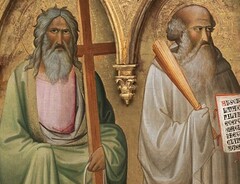 [fig. 2] Detail of Saint Andrew (left), Agnolo Gaddi, Madonna and Child with Saints Andrew, Benedict, Bernard, and Catherine of Alexandria with Angels, soon before 1387, tempera on poplar, National Gallery of Art, Washington, Samuel H. Kress Drove
 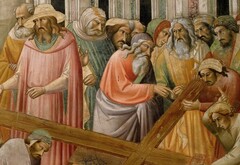 [fig. 3] Item of spectators, Agnolo Gaddi, The Making of the Cross, 1385–1390, fresco, Cappella Maggiore, Santa Croce, Florence. Image: Scala/Art Resource, NY
Clowes collection, Indianapolis Museum of Art: Ian Fraser et al.,A Catalogue of the Clowes Collection, Indianapolis Museum of Art Bulletin (Indianapolis, 1973), 6. Bruce Cole,Agnolo Gaddi (Oxford, 1977), 27, rightly observed the "very close stylistic and positional relationship with the Washington saints," deducing from this analogousness that "both works were in the creative person'due south shop at the same fourth dimension." Possibly information technology would exist permissible to speak of the reuse of the same model employed for the Washington triptych in some other similar and slightly subsequently triptych, of which the panels at present in Indianapolis formed function. I doubtable, however, that the Indianapolis panels belonged to the triptych of the Nobili chapel in Santa Maria degli Angeli, the Florentine church building of the Camaldolese guild (run across notes 21 and 23 in a higher place). In fact, the lost framing pilasters of the triptych now in Berlin could have contained, to estimate from their measurements, two of the Indianapolis panels superimposed on each side. Information technology is as well worth pointing out that the paintings in the American museum come — like the Berlin triptych — from the Solly collection, and that the white addiction with which Saint Benedict and the other monk immersed in reading are portrayed would have been very suitable to adorn a chapel in a church belonging to the Camaldolese club (a reformed branch of the Benedictines). Laurence Kanter informs me that he is about to publish further evidence for identifying the Indianapolis saints and their counterparts at the University of Gottingen every bit the front and lateral faces of the framing pilasters of the Nobili altarpiece, together with the missing pilaster base from the altarpiece predella.
Miklós Boskovits (1935–2011)
March 21, 2016
williamsthislem90.blogspot.com
Source: https://www.nga.gov/collection/art-object-page.206122.html
0 Response to "What Is the Outline of an Object in Art"
Post a Comment