Manipulate Pixel Art With Shaders What Can You Do With Pixel Shaders
Constructing a Pixel Art Shader
Goal: Construct a 2D Shader that can be used past Unity's TrailRenderer
I'd recently been wondering how to create dynamic pixel texture effects, such as beams or trails done in a pixel style. Shortly afterwards, I saw a postal service on twitter that demonstrated a really cool matter: a dynamically generate pixel trail behind a projectile!
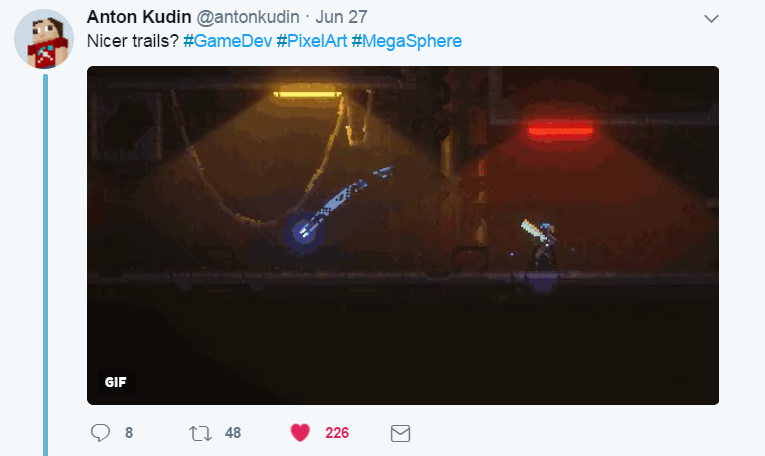
Wow! Upon request the user, he said it was all done with a Trail Renderer in Unity and a custom shader. This wasn't the first fourth dimension I'd heard of the dark magic of shaders, so I decided to try my paw at this technique, and I came up with the following effect:
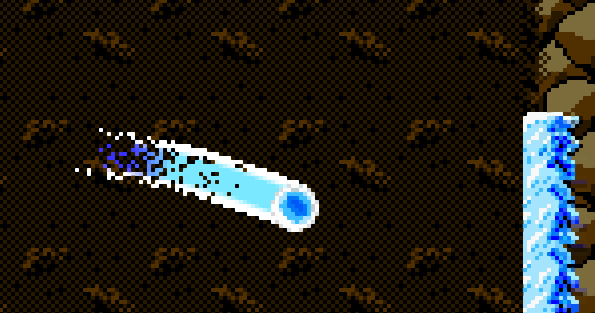
Swell! It fits all the criteria I was looking for: it snaps to the pixels in the scene, information technology has an outer and an inner trail, and its pixels gradually become transparent. And so how does information technology work? Read on to find out my method for stumbling into something that looks kinda peachy.
Basics of a Shader: Different Parts
So what exactly is a shader? Just, a shader is a plan that alters an image past procedurally affecting the lighting, underlying color hue, or other factors to produce a desired visual effect. The proper name "Shader" refers to a popular use of introducing gradual light and shadows to simulate light falling on the image. Since Unity treats 2D objects as 3D surfaces under the hood, nosotros'll have to get in a bit more in depth on how they're treated in the engine. Nosotros'll talk about 2 kinds of shaders: Vertex Shaders and Fragment (or Pixel) Shaders.
The Vertex Shader performs calculations once for each vertex of the polygons nosotros shade, and is executed before the fragment shader. In the vertex shader we assemble the information that volition be sent to the Fragment Shader which can include space relative to the camera, how much fog is introduced, and the location on the texture.
Our Fragment Shader will largely care about the UVs given to information technology. UVs are texture coordinates that relate to the vertexes from which they are derived. Information technology does its calculations in one case (or more, for shaders with multiple passes) for each pixel.
For more caption I highly recommend visiting Michal Piatek's weblog entry hither:
Bones Color Shader

Alrighty, let's get ourselves a basic one color shader nosotros can do some unproblematic manipulation on. Hither's the code for this simple shader, slice by piece.
Shader "Tutorial/SingleColor" { Properties { // Color property for textile inspector, default to white _Color("Main Color", Colour) = (one,1,i,1) } SubShader { Tags { "Queue" = "Transparent" }
"Properties" volition define a color that nosotros tin change in the inspector whatever material we adhere the shader to, and it will default to white. Internally we will refer to information technology as "_Color". Setting the render queue to Transparent will help our Trail Renderer display on tiptop of other objects in the scene. If y'all are using Sorting Layers, you will have to set the Sorting Layer of the Trail Renderer'southward Renderer separately.
Pass { CGPROGRAM #pragma vertex vert #pragma fragment frag #include "UnityCG.cginc" struct appdata { float4 vertex : POSITION; float2 uv : TEXCOORD0; }; struct v2f { float2 uv : TEXCOORD0; float4 vertex : SV_POSITION; };
All of our logic will be within the Pass scope. Commencement nosotros define the fragment and vertex shader methods, and include the library that allows u.s.a. to get photographic camera coordinates, which we'll apply later.
The appdata struct is where we determine what information we volition pass to the vertex shader. Here we define "vertex" with the keyword POSITION equally the vertex position in object space, and "uv" with the keyword TEXCOORD0 which grabs usa the UV. The v2f is what will be passed from the vertex shader to the fragment shader, and we'll be passing some similar stuff, though we'll transform the object coordinates to camera coordinates with UnityObjectToClipPos(5.vertex)
v2f vert(appdata v) { v2f o; o.vertex = UnityObjectToClipPos(5.vertex); o.uv = float4(v.uv.xy, 0, 0); return o; } //externally divers color fixed4 _Color; // pixel shader fixed4 frag(v2f i) : SV_Target { render _Color; // merely return information technology } ENDCG } } }
Whoo, that's the terminal of it. Here we'll grab those camera coordinates, ascertain the color from the inspector for use in the shader with "fixed4 _Color;", and just make a simple shader that only returns whatsoever color the inspector says instead of doing anything fancy.
Pixelization
Real quick I desire to talk about my settings, and why they produce a pixelized epitome. All the pixelized trails y'all see are zoomed in on the game window, and all smooth trails are from the scene view. My settings have a pixel as 1 unit in unity's object space, and I have not found any shader settings that prevent this from occuring in the game view as intended. I may become back and update this later if I need to create larger pixel blocks, only for now this is what works for me.
UV color alteration
Merely, a UV is a texture coordinate. In our trail renderer, UVs will range from 1 to 0 on both the Ten and Y axis. The coordinate system for the Trail Renderer looks like the following:
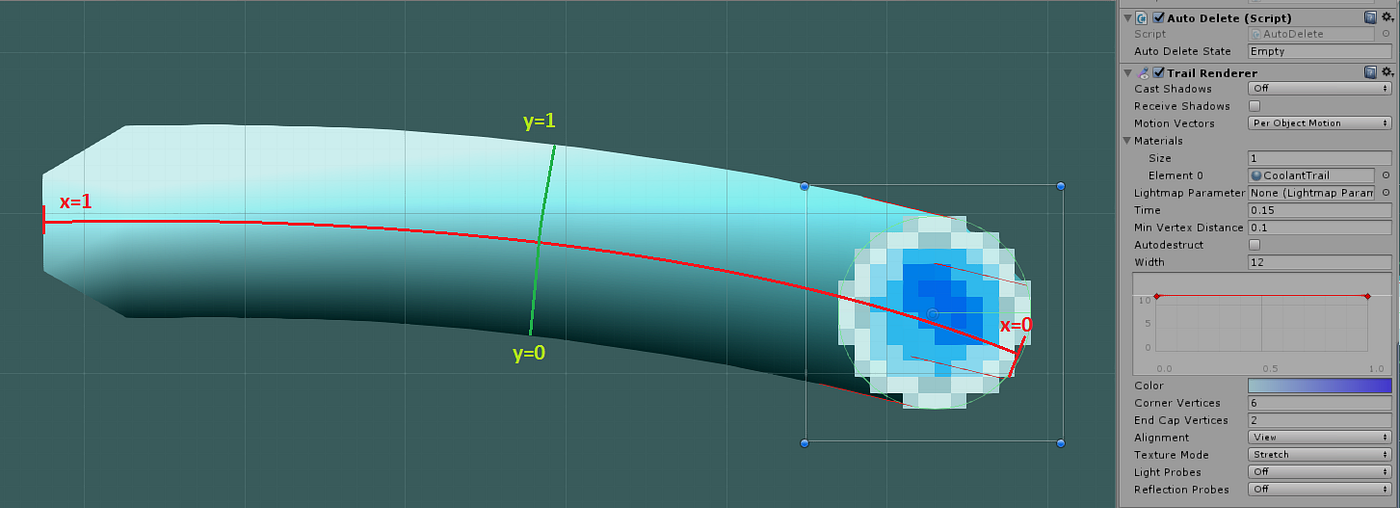
So, the forepart-to-dorsum x coordinate of our trail renderer texture is 0 at the forepart, and 1 at the dorsum. In the Trail Renderer, the full distance this covers is determined by the "Time" variable in the inspector and the objects own movement. The y coordinate, which may appear top-to-bottom, is in fact clockwise-to-counterclockwise, and y=0 will appear at the acme instead of the bottom if the projectile is traveling to the left. Since our stop goal is symmetrical with respect to the X axis we won't have to worry well-nigh this, but other projectiles might. The total distance the y variable covers is determined by the "Width" variable, which tin be fabricated to modify itself over the length of the trail.
Great, so permit'southward get some cool colors in there! This is where the exciting math (wait, please don't leave) comes in that lets united states really make up one's mind what the last effect looks similar. This will be done in the fragment shader role of the program. To start off, allow'southward make a gradual color departure betwixt the centre and extants of the Y axis. To do all this, we'll accept to make certain we're but fading between colors for a fraction of the UV infinite, and so multiply that range N by 1/N.
fixed4 frag(v2f i) : SV_Target { float distY = abs(i.uv.y - .five) * 2; return _Color*distY + _CenterColor*(one - distY); // just return information technology }

So far and then proficient. Just we should make these two colors more distinct. Additionally, allow's make the center part fade to a darker colour. We'll shrink the range of the colour modify fifty-fifty more and innovate a new color shift if we're in the centre.
fixed4 frag(v2f i) : SV_Target{ float distY = abs(i.uv.y - .5) * 2; fixed4 c; if (distY > .vii){ c = _OutsideColor; } else{ if (i.uv.10 > 0.8) c = _InsideFarColor; else if (0.8 >= i.uv.x && i.uv.ten > 0.6){ c = _InsideFarColor*((i.uv.x - 0.vi) * five) + _InsideNearColor*(1 - (i.uv.x - 0.6) * five); } else{ c = _InsideNearColor; } if (distY <= .vii && distY > 0.v){ c = _OutsideColor*((distY - 0.5) * v) + c*(1 - (distY - 0.5) * 5); } } return c; }

Blastoff
We'll have to add together a fleck of actress conditionals towards the meridian of the programme to enable alpha:
SubShader { Tags { "Queue"="Transparent" } Blend SrcAlpha OneMinusSrcAlpha
Smashing! Now, what nosotros want is to gradually increase the charge per unit of alpha=0 pixels towards the 10=1 UV. Showtime, we'll need a random number function for values betwixt 0 and one. Here'south what I utilise in the example:
bladder nrand(float2 uv) { return frac(sin(dot(uv, float2(12.9898, 78.233))) * 43758.5453); }
And when nosotros telephone call it, nosotros'll pass information technology the v2f.vertex value that we set to the camera space position earlier. Just look, if we're using the camera infinite coordinate, isn't that going to be very deterministic? Yes it volition! And this ways that for any given pixel in the fragment shader, there volition be a single indicate along its path where it becomes transparent, giving the effect of many particles that each fade out on their own.
In lodge to make this transition faster and a flake more constrained, we're going to use a power office on uv.x rather than using the raw value. This gives us the terminal file:
Shader "Tutorial/Final" { Backdrop { // Color holding for material inspector, default to white _InsideFarColor("Inside Far Color", Color) = (0.two,0.two,one,one) _InsideNearColor("Within Near Colour", Colour) = (0.5,1,i,1) _OutsideColor("Exterior Color", Color) = (ane,1,1,ane) _MainTex("pixel", 2D) = "white" {} } SubShader { Tags { "Queue" = "Transparent" } Blend SrcAlpha OneMinusSrcAlpha Pass { CGPROGRAM #pragma vertex vert #pragma fragment frag #include "UnityCG.cginc" fixed4 _OutsideColor; fixed4 _InsideFarColor; fixed4 _InsideNearColor; sampler2D _MainTex; float4 _MainTex_ST; struct appdata { float4 vertex : POSITION; float2 uv : TEXCOORD0; float4 color : Color; }; struct v2f { float2 uv : TEXCOORD0; float4 vertex : SV_POSITION; float4 color : Colour; }; v2f vert(appdata five) { v2f o; o.vertex = UnityObjectToClipPos(v.vertex); o.uv = float4(five.uv.xy, 0, 0); o.color = float4(0, 0, v.uv.y, 1); render o; } // vertex shader float nrand(float2 uv) { return frac(sin(dot(uv, float2(12.9898, 78.233))) * 43758.5453); } // pixel shader fixed4 frag(v2f i) : SV_Target { float distY = abs(i.uv.y - .5) * ii; fixed4 c; if (distY > .7) { c = _OutsideColor; if (nrand(i.vertex) > 1 - (i.uv.10 * i.uv.ten * i.uv.x)) c = float4(0, 0, 0, 0); } else { if (i.uv.x > 0.eight) c = _InsideFarColor; else if (0.8 >= i.uv.x && i.uv.x > 0.6) { c = _InsideFarColor*((i.uv.x - 0.6) * five) + _InsideNearColor*(1 - (i.uv.ten - 0.6) * 5); } else { c = _InsideNearColor; } if (distY <= .seven && distY > 0.5) { c = _OutsideColor*((distY - 0.five) * 5) + c*(1 - (distY - 0.5) * five); } if (nrand(i.vertex) > ane - (i.uv.x * i.uv.x)) c = float4(0, 0, 0, 0); } return c; } ENDCG } } }
Thanks for reading!
If yous thought this was absurd, allow me know somehow, mayhap I'll do more than! Feedback of course is always welcome. What was great? What was terrible?
williamsthislem90.blogspot.com
Source: https://thedeivore.medium.com/constructing-a-pixel-art-shader-3753762f6b90
0 Response to "Manipulate Pixel Art With Shaders What Can You Do With Pixel Shaders"
Post a Comment